Fluid Flow & Pressure Analysis
Analyze the movement of fluids inside equipment, ductwork, pipelines, and any other shape. CFD simulations can be used to understand where there are pressure drops, problems with flow distribution, turbulence, etc.
HyperCurve offers professional (Computational Fluid Dynamics) CFD analysis services in India, which enable engineers, organizations and engineering consultants to analyze aspects related to fluid flow, air flow, heat transfer, thermal comfort, ventilation, wind loads, HVAC systems and equipment cooling among other things through CFD simulation techniques.
CFD Fundamentals
Computational Fluid Dynamics (CFD) is a method of engineering simulation which is used for analysing fluid flow, airflow, heat transfer and pressure distribution in real-world applications. HyperCurve offers CFD analysis services in India in order to assist engineers, manufacturers and businesses with evaluating designs, enhancing performance and making decisions based on data. Our experienced CFD consultants in India provide support for simulation projects covering HVAC systems, thermal management, ventilation and industrial fluid flow.
Analyze the movement of fluids inside equipment, ductwork, pipelines, and any other shape. CFD simulations can be used to understand where there are pressure drops, problems with flow distribution, turbulence, etc.
Study temperature profiles, heat transfer, and cooling efficiency within components and systems. Engineers can utilize CFD to analyze thermal behavior and improve designs for efficient heat management.
Identify airflow patterns, ventilation efficiency, and thermal comfort levels in buildings and industrial facilities. Our CFD Consultants in India help evaluate different design options to improve airflow distribution, ventilation performance, and overall system efficiency.
CFD analysis consists of problem definition, creating geometry, generating mesh, setting up boundary conditions, performing simulations, and validation. Our CFD Analysis Services in India assist engineers in knowing about airflow, heat transfer, pressure distribution, and fluid dynamics prior to any design modifications.
First, it is important to understand the objective, the working conditions, the nature of the fluids, and the performance specifications prior to running the simulation.
Sub-services
Create or simplify the 3D model to focus on the regions that influence fluid flow and thermal performance.
Sub-services
Divide the fluid domain into smaller cells to capture flow behavior accurately while managing computational resources.
Sub-services
Define inlet and outlet conditions, material properties, turbulence models, and relevant physical processes.
Sub-services
Run the numerical simulation and monitor convergence to evaluate whether the solution meets the required numerical criteria.
Sub-services
Interpret simulation results through visualizations and engineering metrics to identify performance issues and improvement opportunities.
Sub-services
As a CFD simulation company in India, HyperCurve supports engineering teams with application-focused simulations and technical insights. Our CFD consultants help evaluate complex fluid-flow and thermal challenges, while our CFD services support design validation, troubleshooting, and performance optimization across industries.
Our CFD Services in India cover everything from fluid flow modelling to thermal performance evaluation, helping engineers understand complex flow behaviour, validate designs, and identify opportunities to improve efficiency and overall performance.
Evaluate airflow distribution, ventilation performance, and thermal comfort across indoor and industrial environments.
Prepare and simplify CAD models to create accurate computational domains for reliable CFD simulations.
Develop suitable computational meshes with targeted refinement to capture boundary layers, flow separation, and critical regions.
Simulate velocity, pressure, temperature, turbulence, and heat transfer under defined operating conditions.
Visualize flow patterns, pressure drops, temperature contours, and thermal hotspots to identify potential design improvements.
Deliver clear simulation reports, explain key findings, and recommend design improvements based on CFD results.
Learn about case studies on CFD simulations for industries, renewable energy, residential projects, and commercial ventures. With our CFD Services in India , learn how airflow, heat transfer, ventilation, and wind dynamics can be assessed effectively.
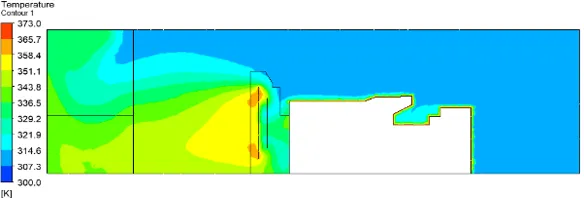
THERMAL & COOLING
CFD analysis of generator-room ventilation, temperature distribution, and hot-air recirculation to evaluate cooling performance under operating conditions.
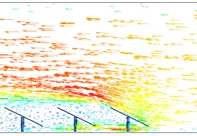
RENEWABLE ENERGY
Wind flow and thermal analysis around solar panel arrays to understand airflow patterns, wind exposure, and potential temperature variations.
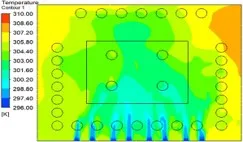
NATURAL VENTILATION
CFD simulation of airflow distribution and thermal comfort in a prayer hall, evaluating ventilation effectiveness across occupied spaces.
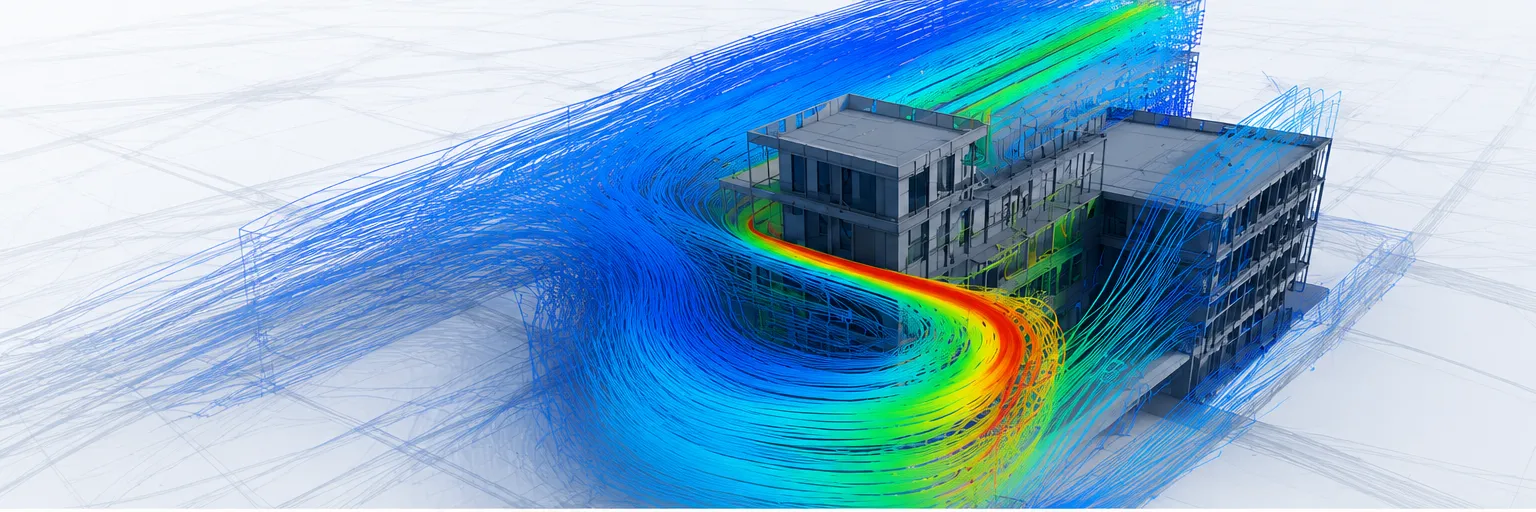
WIND & FLOW ANALYSIS
Wind flow simulation around a commercial building to assess façade exposure, surrounding airflow patterns, and pedestrian-level wind conditions.
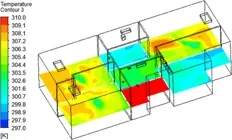
BUILDING AIRFLOW
Analysis of natural ventilation, indoor airflow distribution, and temperature variations to assess residential thermal comfort.
Project descriptions are provided for the listed CFD applications. Confirm project details, images, and outcomes before presenting them as verified completed client projects.
Choosing the right CFD partner requires evaluating technical expertise, simulation accuracy, industry experience, and reporting quality. Compare CFD Services in India to find a team that understands your engineering challenges and project objectives.
Identify the engineering problem you need to solve, whether it involves airflow, heat transfer, ventilation, pressure drop, or equipment cooling.
Look for experience with relevant CFD methods, turbulence models, thermal simulations, and industry-specific engineering applications.
Check the approach to geometry preparation, mesh generation, boundary conditions, and solver selection.
Ask how simulation quality is evaluated through convergence checks, mesh independence studies, engineering benchmarks, and validation where applicable.
Choose a partner that provides clear visualizations, documented assumptions, actionable engineering insights, and communication throughout the project.
CFD FAQs
Quick answers to common questions about CFD simulation, modelling, accuracy, and engineering project deliverables.
CFD simulation uses computational methods to analyze fluid flow, pressure distribution, heat transfer, and turbulence. It helps engineers understand system behavior and evaluate design performance before physical implementation.
Evaluate technical expertise, industry experience, simulation methodology, validation practices, and reporting quality. Comparing CFD analysis services can help you select a provider suited to your engineering requirements.
Typical inputs include CAD geometry, fluid properties, operating conditions, inlet and outlet parameters, thermal loads, and project objectives. Requirements vary depending on the application and simulation complexity.
Reliability depends on appropriate physical models, mesh quality, realistic boundary conditions, convergence monitoring, and conservation checks. Validation against experimental or benchmark data may also be used where appropriate.
CFD simulation supports HVAC, automotive, aerospace, renewable energy, power generation, manufacturing, and building design applications involving airflow, cooling, ventilation, and fluid behavior.
CFD consultants can identify flow restrictions, pressure losses, thermal hotspots, and ventilation issues. Their analysis helps engineers evaluate design alternatives and make informed decisions before implementation.
Depending on the project scope, deliverables may include simulation setup, velocity and pressure contours, temperature plots, flow visualizations, convergence assessment, technical reports, and engineering recommendations.
Project duration depends on geometry complexity, simulation type, computational requirements, and design iterations. Some projects may take a few days, while complex analyses can require several weeks.
Start a CFD Study
Share your project requirements, geometry, operating conditions, and engineering objectives. Our team can help identify an appropriate CFD simulation approach for your application.