Project Case Study

Railway Station Dome — Fire & Smoke CFD Analysis

Jet-fan smoke extraction performance under a 40 MW worst-case platform fire, assessed over a 10-minute emergency scenario.

FDS / Smokeview40 MW Fire Scenario60 Jet FansVisibility Assessment

Fire source

40 MW

Scenario duration

10 minutes

Jet fans

60 × 5,000 CFM

Visibility criterion

≥ 5 m at 1.7 m

Project summary

Project at a Glance

This study assessed smoke extraction and movement across a railway station dome platform under a defined fire scenario, comparing conditions with and without jet fans.

Results include smoke spread, visibility at occupant height, temperature and velocity distributions over the 10-minute scenario.

Fire source

40 MW, 10-minute duration

Jet fans

60 units, 5,000 CFM each

Fan grid spacing

40 m × 20 m

Tenability criterion

Visibility ≥ 5 m at 1.7 m height

Software

FDS / Smokeview

Outputs

Smoke spread, visibility, temperature and velocity distributions

01 / Context

Project Overview

HyperCurve Solutions Private Limited carried out a fire and smoke simulation study for a railway station dome platform to assess jet-fan smoke extraction during a 40 MW worst-case platform fire. The study reviewed smoke spread, visibility, temperature and air velocity throughout a 10-minute emergency scenario using FDS/Smokeview.
02 / Scope

Project Objectives

The study compared smoke behaviour with and without jet fans, reviewed visibility at occupant height, examined temperature near the fire source, and assessed the airflow created by the smoke plume and fan arrangement. The central design question was whether the jet-fan configuration could contain and redirect smoke towards extraction routes while maintaining the stated visibility criterion across most of the platform.

Model preparation

Platform Model and Fire Scenario

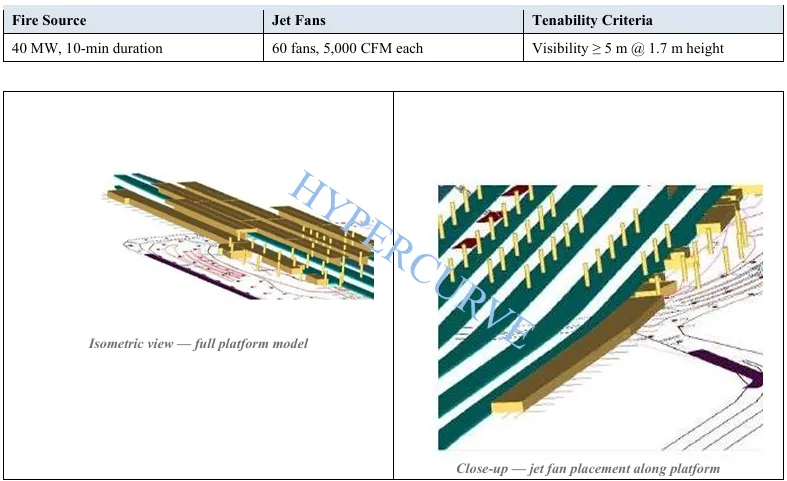
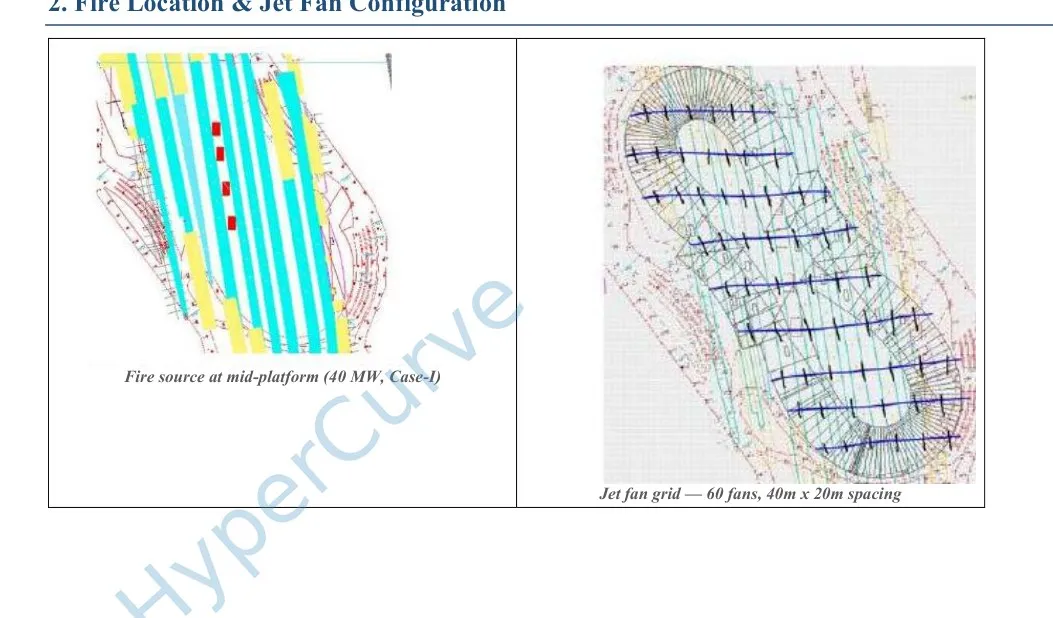
The model represents the railway station platform and dome geometry, with the fire source located at mid-platform for Case I. The report specifies a 40 MW fire with a 10-minute duration. It identifies 60 jet fans, each rated at 5,000 CFM, arranged on a 40 m × 20 m grid. The stated visibility tenability criterion is at least 5 m at 1.7 m above floor level.

Isometric platform model and close-up of jet-fan placement

Simulation setup

Jet-Fan Configuration

The platform model and configuration views show the overall platform geometry, close-up jet-fan placement, the mid-platform fire location and the jet-fan grid. These model views provide the spatial context for interpreting smoke movement and airflow across the platform.

Mid-platform 40 MW fire source and 60-fan grid with 40 m by 20 m spacing
Mid-platform 40 MW fire source and 60-fan grid with 40 m × 20 m spacing

Fire source

40 MW

Jet fans

60 × 5,000 CFM

Fan grid

40 m × 20 m

Simulation results

Smoke Distribution — With and Without Jet Fans

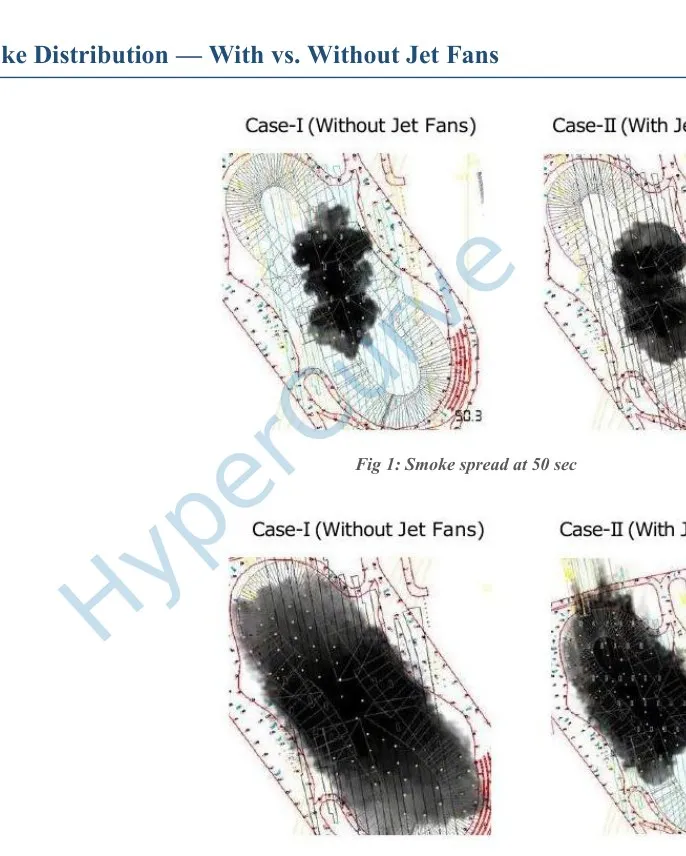
The report compares smoke spread at 50 seconds and 300 seconds for a baseline case without jet fans and a case with jet fans active.

Smoke spread at 50 seconds and 300 seconds, comparing cases without and with jet fans

Without jet fans

The baseline case shows smoke spreading freely across the platform.

With jet fans

With jet fans operating, smoke remains more contained and is pulled towards extraction points rather than spreading freely across the platform.

Tenability

Visibility at Occupant Height

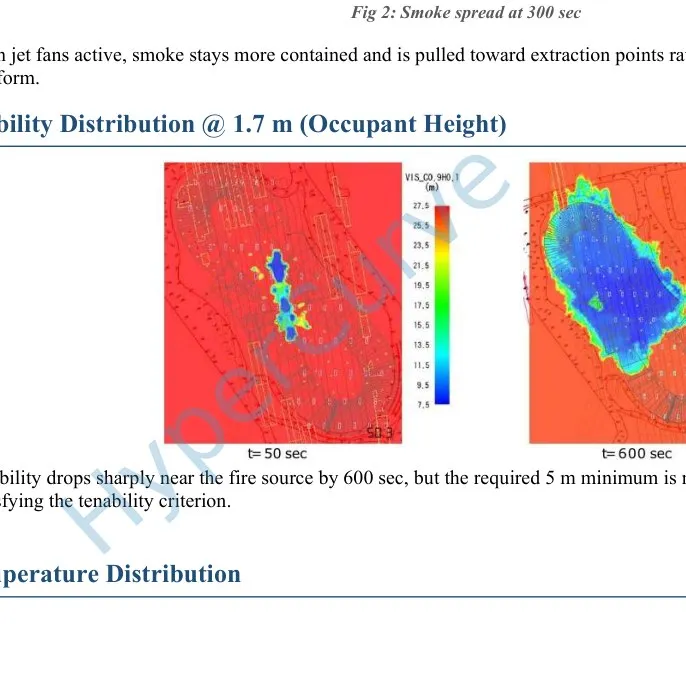
Visibility contours are evaluated at 1.7 m above floor level.

Visibility distribution at 1.7 m occupant height at 50 and 600 seconds

The report states that visibility drops sharply near the fire source by 600 seconds, while the required 5 m minimum is maintained across most of the platform.

This is the visibility criterion identified in the report; the result should be read in the context of the modelled scenario and the report's stated assumptions.

Thermal behaviour

Temperature Distribution

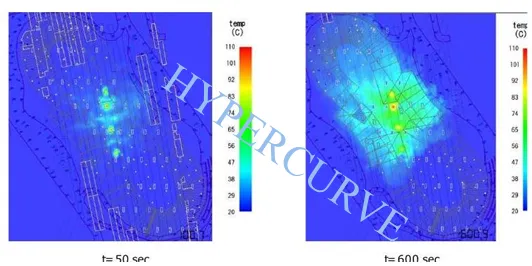
Temperature contours at 50 seconds and 600 seconds show the thermal impact of the fire over time.

Temperature distribution at 50 and 600 seconds

The report states that peak temperatures remain localised near the fire source and that surrounding platform areas remain within the limits described as safe in the source report, including at 600 seconds.

Compare the 50-second and 600-second contours to see how the thermal footprint develops around the fire source.

Airflow behaviour

Velocity Distribution

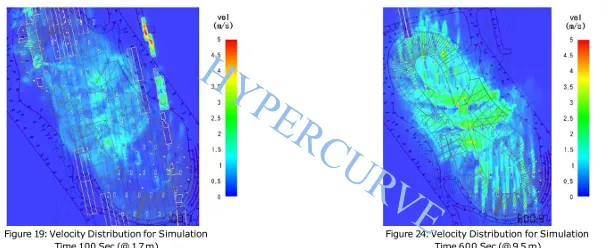
The velocity results show high-velocity flow of up to 5 m/s directly above the fire, driven by buoyancy.

Velocity distribution showing flow up to 5 m/s around the fire plume

The plume strikes the roof and deflects sideways, consistent with the smoke-plume behaviour described in the report.

These flow patterns help explain how hot gases interact with the dome and platform geometry.

Engineering interpretation

Key Findings and Design Implications

These findings summarise the supplied report's stated simulation results. They are not an independent validation of measured site performance.

01

Smoke containment

The 60-fan configuration at 5,000 CFM per fan and 40 m × 20 m spacing contains smoke and redirects it towards extraction points, compared with the no-fan baseline.

02

Visibility criterion maintained

Visibility remains above the 5 m criterion at 1.7 m across most of the platform during the 10-minute scenario, dropping sharply only near the fire source.

03

Localised thermal and velocity effects

Peak temperatures and high-velocity plume flow stay concentrated around the fire region, with surrounding platform areas within the limits stated in the report.

The report concludes that the current configuration meets its stated tenability requirements for the modelled 40 MW scenario. Final design validation and applicable code-compliance review should still be based on the complete project requirements and approval process.

Project outputs

Project Deliverables

The study provides model views and visual result outputs to review smoke movement, visibility and thermal conditions on the platform.

  • Railway platform and dome CFD/FDS model review
  • Fire source and jet-fan configuration views
  • Smoke spread comparison with and without jet fans
  • Visibility distribution at 1.7 m occupant height
  • Temperature distribution at 50 and 600 seconds
  • Velocity distribution and plume behaviour review
  • Summary of findings against the stated visibility criterion